
The number 10. For many, this is just a simple number, like any other. For a football addict such as myself, the first thing that crops to mind, rather than times tables, are trequartistas. Only a football fan can describe a number nine as false. The triggering of some sort of OCD when anyone but a left back wears the number 3 on their shirt. Yet this obsession with numbers stems from something far more complicated than squad numbers or numeracy: the world of the football tactic. Football is often like the world of fashion; things are often in vogue and then back out very rapidly. Nothing more so than tactics. A successful formation that is truly original stays so for a very short period of time, before admirers and rivals take ‘inspiration’ and copy it, sometimes improving upon it, but often never getting close to the original. When the next sure-fire way to win crops up, it’s out with the old and in with the new. There are numerous examples of this, such as the libero of European football. The sweeper has not been used commonly by big clubs since the early to mid-90s, with the back four far more common. In the modern game, a back four is almost a given, albeit the manner in which it is used (flat back four or wingbacks, low or high block, etc) changes, it’s what is ahead of this that is the interesting bit.
Let us jump in the footballing Tardis and go back to 1999. Manchester United had just sealed the Treble in the Nou Camp with one of the most astonishing comeback wins in history. The system played that night, and that season? 4-4-2. Go back in the Tardis another 11 years and we see the Crazy Gang beating the Culture Club, as John Motson so amazingly put it. The formation Wimbledon played that afternoon at Wembley? 4-4-2. The numbers are the same, but watch that Wimbledon side play and watch that United side play, and the difference is astonishing. It shows the difficulty of the concept of explaining how a side plays by using a couple of numbers.
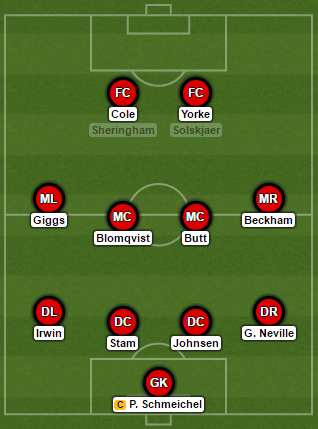
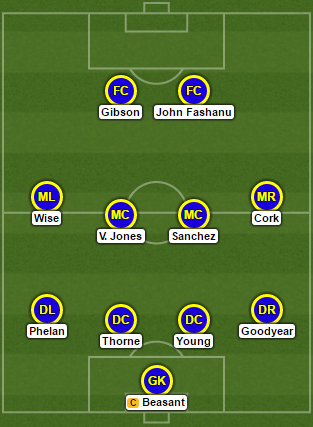
Same formation but very different styles of play. Left, Man Utd’s XI that won the 1999 Champions League Final (without Scholes or Keane); Right, Wimbledon’s XI that beat Liverpool in the 1988 FA Cup Final. United used fast passing and wing play, the Dons used route one football. Yet both used a 4-4-2.
It’s often easier to refer to tactics by the clubs/managers that used them and the era they were in, for example, Pep’s Barça is often referred to by experts, and is an easy way to refer to a particular brand of football. This side is one I’ll come back to towards the end of the article, but first, let’s go back to the beginning of the modern game.
The first widespread formation that swept across the game was the 2-3-5. This is the formation that many footballing traditions hark back to; the first shirt numbering system, of 1 to 11 was brought in when sides were using this, and as the formations warped into others, it brought what we recognise as the modern numbering system; as well as the table game of Fussball, which to this day still uses that 2-3-5. Then came the WM, an altered version of the 2-3-5 (in numbered terms, it’d be a 3-2-2-3), pioneered by Herbert Chapman, of Highbury Marble Hall Bust fame. Eventually, through various different evolutions, we came to the 4-4-2 that was common in England by the 1960s. (NB: For more detailed information about this evolution, I recommend reading Inverting The Pyramid by Jonathan Wilson, an excellent book which chronicles the evolution of tactics across the world, and upon which much of this article is inspired. This article is based mainly upon English football, but the book’s chapters about catenaccio and South American football are fascinating.)
The 4-4-2 was dominant in England for almost 40 years at the top level, and lower down the league pyramid is still prevalent. As said earlier, there can be massive difference between tactics which share a formation, and a similarity between tactics with different formations; for example, Chelsea’s 4-3-3 of the first Mourinho era bears more resemblance to a 4-5-1 than the traditional 4-3-3, of a side like the ‘Wingless Wonders’ that won England the World Cup in 1966.
The stereotypical thoughts of a 4-4-2 are usually two banks of four, defensive, and playing the long ball to a little-and-large attacking duo. However, as mentioned before, this is not the case. Sir Alex Ferguson’s Man Utd sides used a 4-4-2 until the 07/08 season and the signing of Carlos Tevez. In addition, back when Arsene Wenger was successful, the two double winning sides of 1998 and 2002, as well as the Invincibles, all played in a 4-4-2 formation. Clearly, none of those sides were a 'hoofball' team.
While some teams had wavered from the dominance of the 4-4-2; namely Glenn Hoddle’s England side which used a 3-5-2 using wingbacks, having been influenced by his time in Monaco in the late 80s; the first large change from the 4-4-2 was influenced by the (first) arrival of Jose Mourinho to Chelsea. In that 04/05 season, the dominant formation used (in tandem with the occasional 4-Diamond-2) was the aforementioned 4-3-3, with the single man up top in the shape of Didier Drogba, and two men on the wings. Despite Mourinho’s reputation as a defensive coach, the reality was many sides were swept aside with ease. Rather than use solely out-and-out wingers like the typical English team would, the use of Duff, Robben and Joe Cole being rotated as starters, and often swapping wings many times during a match, creating a handful for full backs up and down the country. However, when Chelsea weren’t in possession of the ball, the wingers would track back and help out the defence, with the formation becoming a 4-5-1. This formation change became quickly copied across the Premier League, particularly amongst the elite clubs, with Man Utd, Arsenal and Liverpool all quickly adopting the same style of play; for some with great effect, with Man Utd winning 3 league titles in a row with a Tevez-Rooney-Ronaldo front line, and Liverpool getting to the 2007 Champions League Final with the midfield trio of Xabi Alonso, Mascherano, and Gerrard; for others, like Arsenal, the change was unsuccessful as the Invincible side was broken up and replaced with great players like Fabregas and Adebayor, but somehow success never followed (with mentality often questioned; tactics and players aren't everything.)
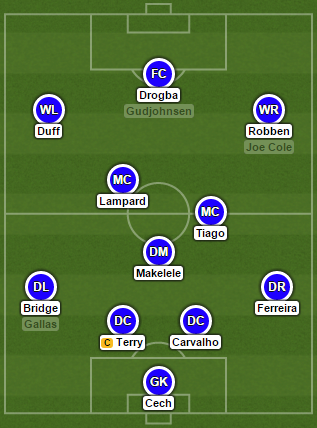
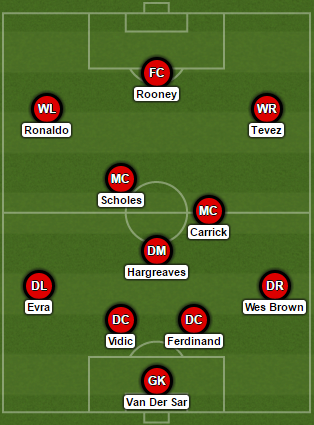
Left, Chelsea’s typical side in 04/05 based on appearances; Right, Man United’s starting XI from the 2008 Champions League Final. The 4-3-3 had spread throughout the Premier League to become the dominant formation over the 4-4-2
For nearly a decade after Mourinho declared himself the Special One, the 4-3-3, and the 4-5-1, which as said earlier is essentially the same formation but with the wingers deeper, and was often used by smaller Premier League sides to hold and counter the bigger clubs. On the continent, many of the European elite used the 4-3-3, most famously Barcelona under Pep Guardiola, who, once he had switched Samuel Eto’o onto the wing and Lionel Messi alone up top as a false nine, had created what would become known as the 4-6-0, where the midfield would be packed with technical players (usually 2 Defensive Midfielders, 2 Wingers and 2 Attacking Midfielders), and was used during the 2010 World Cup and Euro 2012 by a Catalan-dominated Spain side. However, the 4-6-0 never really grew on British shores, bar a bizarre display by Craig Levein’s Scotland side in a qualifier against the Czech Republic, and a couple occasions by an injury-struck Chelsea in Mourinho’s second spell.
The next great fad grew out of Bayern Munich’s season of 11/12, which turned out to be a failed one, as they came 2nd in the Bundesliga and lost the German Cup Final, both to Borussia Dortmund, and then the Champions League Final in their own stadium to Chelsea. Despite this, the next season they did the Treble, using much the same system, of the 4-2-3-1. The use of Thomas Muller in the number 10 role, as a Raumdeuter, German for “space invader” (no, seriously), rather than as the more orthodox role of Trequartista, Italian for “three-quarters”, as in three-quarters of a forward, was unique to Bayern. Some described this role as being a “Central Winger”, with hallmarks of traditional wing play being exhibited, whilst being utilised in the middle of the park. After the 11/12 season, the 4-2-3-1 started to grow in English football, most notably at Chelsea, who, after winning the Champions League, spent a lot of money entirely revamping their squad, with Eden Hazard and Oscar brought in at a joint cost of £52.5 million. These two combined on the left and right wings respectively with Juan Mata in the number 10 role, creating a deadly attacking midfield trio in behind the riddle wrapped in a mystery inside an enigma that was Fernando Torres. This trio would rotate positionally, similar to the way Mourinho’s two wingers in 04/05 would chop and change, making it extremely difficult for defenders to track the runners. After this, the 4-2-3-1 would become, and still is, the dominant formation in English football, with teams from Arsenal and Man United to Swansea and Newcastle using this setup.
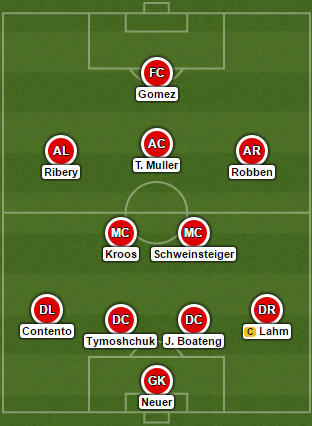
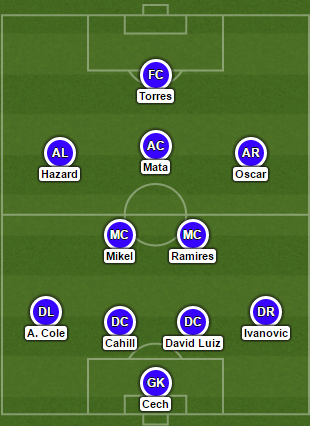
Left: Bayern Munich’s losing team in the 2012 Champions League Final; Right, Chelsea’s starting XI against Spurs in September 2012, an XI typical of that season. The 4-2-3-1 was in full swing, with even Championship sides trying to emulate Bayern.
With this 4-2-3-1, came the modern obsession with playing possession football, with slow, intricate build-up play made up of short passes, building from the back into the final third. This came from the aforementioned tiki-taka of Pep’s Barca side, which impressed nearly everyone in football. It became common for every team to want to get on the ball and build, however, this led to many sides trying to run before they could walk. For example, Blackpool’s only season in the Premier League ended in relegation despite winning plaudits and admiration for their style of play. In a results-based business, man cannot live on plaudits alone.
---
So, we’ve spoken at length about the past, so what is for the future? It is obvious to say that the next evolution in formations and tactics is to come from our past, it’s just a case of how long ago. There have been flirtations with the back 3 in recent years, with both Brendan Rodgers at Liverpool and Louis Van Gaal at Man United experimenting with them in the 14/15 season before returning to a back 4. The back 3 hasn’t been common on these shores since the days of the WM, but continues to thrive on the continent, particularly with perennial Scudetto winners Juventus. On the point of the WM, commentators have said that Guardiola’s Bayern side this season have been playing a WW, or a 2-3-2-3, with wing-backs pressed so far forwards that their automatic resting place is in line with the defensive midfielder, and then two attacking midfielders in behind a front three like that in a 4-3-3. The entire formation is practically a more offensive version of the 4-3-3, with the wing backs and two non-holding midfielders pushed much further forward. With Guardiola’s arrival at Manchester City this summer, it will be interesting to see whether there will be many hours in the state-of-the-art Etihad Campus in an effort to bring this formation to the Premier League.
However, even before his arrival was confirmed, Guardiola has had a massive effect on this season. With the aforementioned obsession with possession football, it has brought with it a set of sides who are proficient on the counter-attack, none better this season than Leicester. For the last decade, all Premier League champions had had an average possession over 50%, often closer to 60%, whereas so far this season Leicester’s is closer to 40%. If teams play attacking, possession football, it’s very easy to sit in a low block, hold out for a result, especially if you do a good job of capitalising on any mistake the possession-based side makes; Chelsea showed this in the Nou Camp in the 2012 Champions League Semi Final, and Leicester have been showing it all season. Another influence Leicester have had on the possible future of tactics in the English game is the return of the strike partnership, and maybe even the 4-4-2. Whilst neither of these truly died out; with Man City winning the league with Aguero-Dzeko a commonly played partnership in 11/12, and Suarez-Sturridge practically dragging a defenceless Liverpool excruciatingly close to the finish line in 13/14;
neither side played with the efficiency that Leicester do.
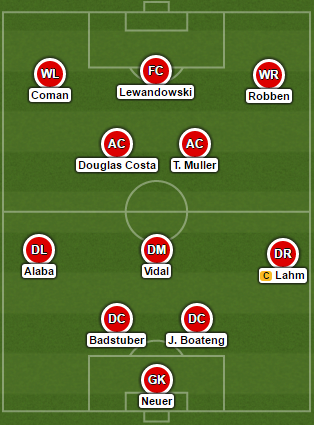
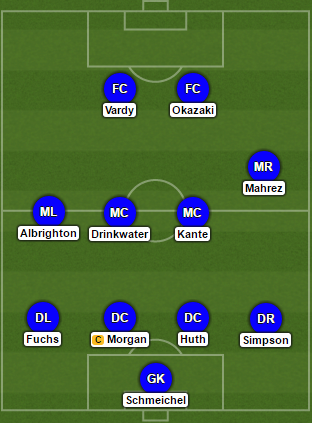
Left: Bayern and Guardiola’s ‘WW’; Right: Leicester and Ranieri’s 4-4-2. Suggestions are that one of these will be the dominant formation in next season’s Premier League.
The modern game has required a 3 man central midfield to be competitive for the past decade, and so to play 2 in that position requires players with a lot of strength and dynamism, something Kante and Drinkwater have in abundance. Albrighton and Mahrez’s ability to get forward to support Vardy and Okazaki, and then back to support their fullbacks, is a key to the success of their counter-attacking proficiency. Most importantly, though, is that front two. Okazaki, a very good striker in his own right, is unselfish in the way he drags defenders with his runs to create space for Vardy and Mahrez to run into, something Troy Deeney, also a great striker himself, does for Odion Ighalo at Watford. Pundits have argued that some defenders have simply grown unaccustomed to facing two strikers and having to man mark, rather than a sole striker who is marked by one, and the other is covering. This is probably true: there will be an entire generation of centre-back who has grown up playing, and being trained to play, against a solo man up front. When you stick two up front, especially with the pace, dynamism and quality of Vardy and Okazaki, or Deeney and Ighalo, it can be extremely difficult. It says a lot about the effect those two duos on this season that many of the footballing public are crying out for a Kane-Vardy partnership up front for England.
If I personally had to hedge my bets for the future, in the short term, of football tactics in England, I think that for the traditional elite, despite the Leicester effect of this season, whether they win it or not, they will stick with their more attacking formations and their possession-based football, with Guardiola continuing to experiment, presumably until he ends up playing Joe Hart as a false nine. However, as previously mentioned, Guardiola has been shown to be easy to beat on the counter when playing with a very deep defence, and you can bet your bottom dollar there will be points taken off of Pep by people like Pulis and Big Sam. Meanwhile, Claudio Ranieri will be taking the Vardy and Mahrez show on its European tour, and after the manner in which they’ve taken the Premier League by storm, who can predict what they’ll do in the Champions League? One thing is for sure: European defences will like a front two even less than English ones do.

No comments:
Post a Comment